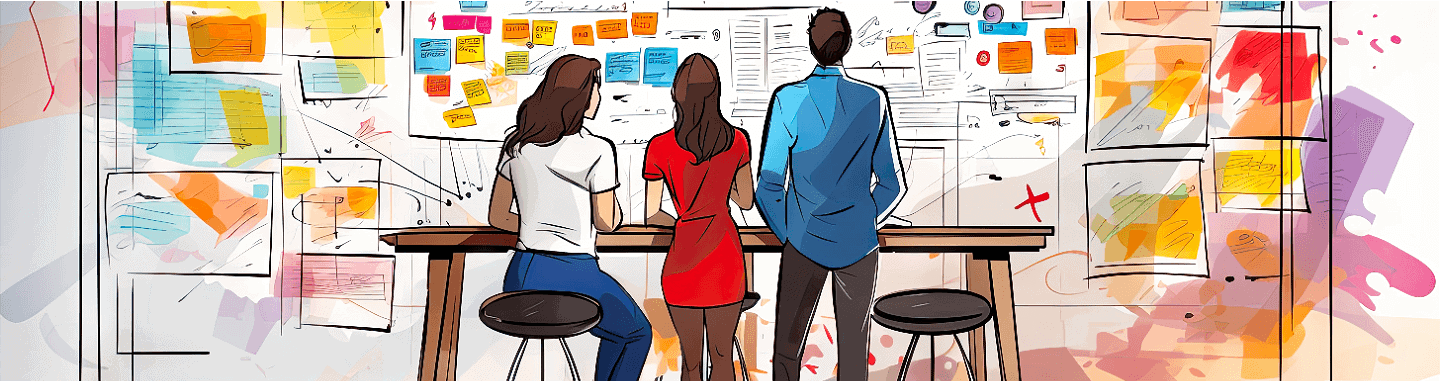
I want to tell you about a company I once worked with. They were convinced they had an innovation problem. They spent a small fortune building a beautiful, glass walled “Innovation Hub” in the middle of their office. It was full of colorful beanbag chairs, high tech whiteboards, and a very expensive espresso machine.
Six months later, I walked by. The whiteboards were pristine. The beanbags were empty. The only sign of life was an employee from the finance team who was quietly using the espresso machine because it was better than the one in the kitchen.
The “Innovation Hub” had become a museum to a good intention.
This story is one I have seen play out in dozens of ways. We build a suggestion box that just collects dust. We run a “hackathon” that produces a few fun ideas that are never spoken of again. We, as leaders, sit in a meeting and ask, “Alright, who has an innovative idea?” and are met with complete silence.
Here is the truth I have learned: Most organizations do not have an idea problem. They have a culture problem.
We say we want innovation, but our day to day culture, our meetings, and our unwritten rules often punish the very things required to get it. We want the new, but we are terrified of the messy. We want the breakthrough, but we have zero tolerance for the failures that lead to it.
As L&D professionals, as HR leaders, as managers of people, we are in the privileged position to fix this. But it requires us to stop buying beanbag chairs and start building a new foundation. It requires us to redefine innovation itself.
Innovation is not just the “next iPhone.” It is not a lightning bolt that strikes a lone genius. Innovation, in its most practical and powerful form, is simply “finding a better way to do what we do.”
When we define it like this, innovation is suddenly democratized. The finance employee who builds a better spreadsheet model is an innovator. The customer service rep who re-thl-I-N-K-S their script is an innovator. The manager who runs a more effective, shorter meeting is an innovator.

When you look at it this way, our job becomes clear. It is not to find innovators. It is to create a culture where everyone can become one.
The Real Root of Innovation: Psychological Safety
Table of Contents
Let’s start with the most important concept. You cannot have innovation without psychological safety.
Psychological safety is the shared, unspoken belief that a team is safe for interpersonal risk taking. It is the feeling that I can speak up, ask a “stupid” question, admit I am lost, challenge the status quo, or present a half formed idea without fear of being shamed, embarrassed, or seen as incompetent.
Think about it. An innovative idea is, by definition, new. It is unproven. It might be wrong. It is fragile.
If I am in a meeting, and I have a 10 percent idea, a tiny seed of a thought that might be something, will I share it?
- In a low safety environment, I will absolutely not. I will stay quiet, because if I share it, my boss might think it is dumb. My peers might point out the flaws. I will be seen as “not strategic.” So, I protect myself, and the idea dies.
- In a high safety environment, I will say, “This might be crazy, but what if we…” I will share the 10 percent idea, and then a colleague, feeling safe herself, will build on it. She will add another 20 percent. Someone else will connect it to another project. And suddenly, the team has turned a 10 percent spark into an 80 percent solution.
Your original post noted that “open communication works wonders.” This is true, but psychological safety is the “how.” It is the soil from which open communication grows. As leaders, we build this by:
- Modeling Vulnerability: Go first. Be the first to say, “I am not sure I understand, can you explain that again?” or “That assumption I made was wrong.”
- Thanking for Dissent: When someone challenges your idea, your gut reaction is to defend. Instead, say “Thank you for that perspective, tell me more.” You are actively rewarding the very behavior you want.
- Separating the Person from the Idea: We can critique an idea without critiquing the person who brought it. Frame all feedback as a shared quest for the best outcome.
Without this foundation, nothing else I am about to share will work.
The Leader’s Most Important Job: De-Risking Failure
The original article had a great, short point: “Tweaks get results.” It hinted that the first version of any idea will be flawed. I want to take this and blow it up, because it is the second most important part of our jobs.
We must stop treating failure as a sin and start treating it as data.
In a typical corporate culture, a “failed” project is a career-limiting-move. We write a report, we blame “market conditions,” and we secretly assign blame to the team leader. Everyone learns the lesson: “Do not try anything risky.”
A culture of innovation does the opposite. It distinguishes between sloppy failure (due to cutting corners or incompetence) and intelligent failure (a well-run experiment that produced an unexpected result).
An intelligent failure is, quite simply, the cost of new information.
As leaders, we are the ones who set this tone. Your team will not look at the employee handbook; they will look at you the first time a project goes sideways. How you react in that moment defines the culture for the next five years.
Here is how you de-risk failure:
- Run “Pre-Mortems”: Before you start any new project, gather the team and ask this one question: “It is one year from now, and this project has failed completely. What went wrong?” It is a brilliant way to surface risk, voice dissent, and plan for contingencies, all under the “safe” umbrella of a hypothetical exercise.
- Reframe the Language: Stop using the word “failure.” Start using words like “learning,” “data,” or “pivot.” When a project does not work out, the only question that matters is, “What did we learn?”
- Celebrate the “How,” Not Just the “What”: We always celebrate the team that hits a home run. But what about the team that ran a perfect, data-driven experiment that proved an idea would not work, saving the company millions? We need to publicly celebrate that team. When you celebrate an intelligent failure, you send a shockwave of permission across the entire organization.
Moving from “Innovation Events” to “Innovation Habits”
The “Innovation Hubs” and “Hackathons” I mentioned earlier are events. They are temporary and separate from the “real work.” And that is why they fail.
You do not need a hackathon. You need habits. You need to weave innovative thinking into the daily fabric of your team’s life. The original post was right to say, “Motivate your team to be curious” and “Everyone takes ownership.” But how do we do that? We build habits.
Here are a few practical habits you can start in your next team meeting:
1. The Habit of Insatiable Curiosity The original post mentioned Samsung and Airbnb as examples of being curious about consumers. This is exactly right. Those companies institutionalized curiosity.
- How to do it: Start every project kickoff by asking “What problem are we really trying to solve?” and “What do we believe to be true that might not be?” Encourage your team to spend time with your customers. Not just in formal surveys, but in real, human conversations.
2. The Habit of Constructive Dissent
- How to do it: In a meeting, never accept unanimous agreement on a big idea as the final word. Actively mine for dissent. Try saying, “I am not looking for agreement right now. I am looking for what we are missing. What is the argument against this?” This gives people the social permission they need to speak up.
3. The Habit of “What If”
- How to do it: Carve out 10 minutes in a weekly meeting for “What If.” No idea is bad. “What if we stopped doing this report?” “What if we charged our clients in a totally different way?” “What if we treated our internal department like an agency?” The goal is not to create a to do list. The goal is to exercise the muscle of possibility.
4. The Habit of Cross Pollination Innovation rarely comes from a vacuum. It comes from two old ideas colliding to make a new one. But that cannot happen if everyone is stuck in their silo.
- How to do it: Encourage “demos” or “show and tells.” Have the marketing team present their process to the engineering team. Have finance show sales how the billing actually works. These “aha” moments, where one person says, “I never knew you did that! We have a tool that could help,” are the building blocks of internal innovation. This is how you build a team where shared goals and values become more than just a poster on the wall.
Also read: How Shared Values Can Empower a Team
It Starts at the Beginning: Hiring for Innovation
The original article was smart to point out that this can be “embedded in the hiring process.” I want to double down on that. You can, and should, screen for an innovative mindset.
But be careful. Most people say they are innovative in an interview. You need to dig deeper with behavioral questions.
Instead of asking, “Are you an innovative person?” try asking:
- “Tell me about a time you had to solve a problem with very few resources.” (This screens for scrappiness and creativity).
- “Describe a time you challenged your boss or a team consensus. What was the situation, and what was the outcome?” (This screens for courage and psychological safety).
- “Tell me about a project you worked on that failed. What happened, and what did you learn?” (This screens for resilience and ownership).
- “What is something new you have taught yourself in the last six months?” (This screens for curiosity).
Their answers will tell you far more than a simple “yes, I am a creative thinker.”
The Takeaway: You Are the Architect
As leaders and L&D professionals, our takeaway is this: Innovation is not a department. It is a cultural outcome.
It is the harvest we get when we plant the seeds of psychological safety. It is the music that flows when we give people the instruments of curiosity and the permission to play.
Our job is not to be the “Chief Innovator.” Our job is to be the Chief Architect. We are the designers of an environment, a culture, and a set of daily habits where the natural, human impulse to “find a better way” can be unleashed in everyone.
Stop trying to manage innovation. Start creating the conditions for it.
Build Your Culture of Innovation
Creating this kindof resilient, curious, and psychologically safe culture is a process. It takes practice and intention. If you are ready to move beyond “innovation theater” and equip your leaders and teams with the real skills to build a truly innovative culture, we can help.Explore how FocusU’s services can help you design a learning journey that builds the core habits of innovation, not just for a day, but for the long haul.